


























Testosterone Supplement Guide: 5 Key Ingredients Explained

You’ve probably seen them everywhere: Boron, Zinc, Fenugreek, etc.
They appear on bottles promising better stamina, energy, performance and “healthy testosterone levels". But if you're searching for a testosterone supplement, how do you know what these ingredients actually do?
The truth is that not all elements are created equal, nor are all advertising claims strongly backed by science.
Here's how we're going to break down the 5 most common ingredients in a men’s testosterone supplement, what studies say about them, and what you can truly expect from them.
1. Panax Ginseng: More Than an Energy Ingredient
Panax ginseng has been widely incorporated in wellness supplements for boosting energy levels and stamina. In addition to that, some studies have examined its potential for recovery of muscular strength, fatigue, and as a sexual enhancer.
Nevertheless, when considering a men's testosterone product one is probably better off considering ginseng as more of an overall wellness component in these products instead of a testosterone booster. Although some research results are quite encouraging there is not an overwhelming confirmation yet.
The takeaway
Panax ginseng probably can help with energy levels and performance, but more investigation is needed to clarify its effect on testosterone.
2. Boron: A Small Mineral With an Interesting Role
Boron is a trace mineral which has gained popularity for having a possible link to steroid hormones and testosterone.
A few clinical studies on this link have been conducted, but they are small and should not be considered as conclusive.
Since boron is a fairly new ingredient in testosterone boosters, it would be better to conduct further research so that people can make strong claims on its use or effects at all.
The takeaway:
Boron may be the right stuff you’re looking for, but there’s a long way to go before we fully understand its effects on testosterone.
3. Zinc: Important, But More Isn't Better
Zinc is different from most herbal ingredients on this list. It's an essential mineral required for normal immune function, metabolism, cell processes and reproductive health.
Zinc also has a relationship with testosterone.
Some studies say low testosterone can be associated with low levels of zinc. And correcting a deficiency may help to keep testosterone levels normal.
But that doesn't mean taking more zinc will automatically mean more testosterone.
If your body already gets enough zinc, adding increasingly high amounts isn't necessarily beneficial.
The takeaway
Zinc is important for normal health, particularly when intake is inadequate. But a good men's testosterone supplement shouldn't rely on the idea that consuming more of an ingredient is always better.
4. Fenugreek: Another Familiar Name
Fenugreek is another ingredient frequently found in testosterone-support formulas.
Researchers have studied fenugreek extracts in relation to testosterone, body composition and exercise-related outcomes.
Some clinical studies show potential benefits for testosterone-related measures, yet results vary between researches. Differences within the extract, individuals, and examination of the configuration can all have an impact on the outcome.
So when you see fenugreek in a testosterone supplement, don't expect the aspect to absolutely produce the same results for everyone.
The takeaway:
Fenugreek has encouraging research behind it, but more evidence is needed to understand its effects fully.
5. Astragalus membranaceus: The Lesser-Known Ingredient
Astragalus membranaceus may be less familiar, but this plant-based ingredient has been researched for areas such as immune function, inflammation and general wellbeing.
In contrast, research examining Astragalus’s ability to directly affect testosterone levels has been very limited compared to Fenugreek or Zinc.
That's worth keeping in mind when reading supplement claims. Not every ingredient needs to directly raise testosterone; some may have a broader role within a wellness-focused formula.
The takeaway:
Astragalus is a cool plant ingredient, but more human studies are needed to determine if it actually helps with testosterone.
What Should You Look For in a Testosterone Supplement?
Instead of selecting a product just because it lists more ingredients, first consider these basic queries:
1. Are the ingredients explicitly listed?
It is much better that the product explicitly specifies the name and amount of every single ingredient than being covered up under the guise of proprietary blends, which usually just hide the poor quality.
2. Was it researched on people?
Animal studies give us some idea, but human clinical trials are the gold standard for real proof.
3. Is the research validating the claim made?
For example, a component that has been examined for the alleviation of stress does not necessarily mean that it will increase testosterone as well.
4. Is quality testing available?
It is very difficult to judge the authenticity of a product just by the package if the company does not provide details with regards to quality testing of the final product that is being sold. Especially with products like shilajit, where source and processing are really important.
5. Are the claims genuine?
Watch out for products claiming to change your hormones overnight, make you huge or give you 110% guaranteed results; those are just unrealistic.
Where Does a Plant-Based Formula Fit?
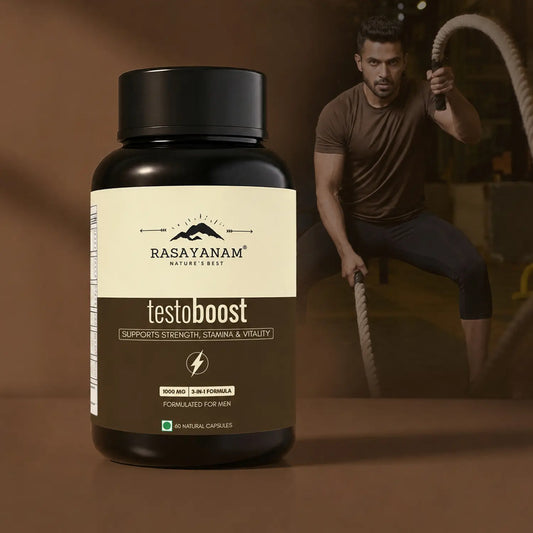
This is where a focused formulation can make the ingredient list easier to understand. Rasayanam’s Testoboost brings together Fenugreek, Panax Ginseng, Boron Glycinate, Zinc Bisglycinate and Astragalus membranaceus, with a focus on supporting healthy testosterone levels, stamina, vitality, performance and recovery.
The idea isn't that one testosterone supplement is automatically better than another. It's about knowing what's inside, why those ingredients are included and how much evidence supports their individual roles.
For anyone comparing a men's testosterone supplement, looking beyond the front label can help you make a more informed choice. The list of ingredients, quantities, quality standards and strength of the research all warrant a closer look.
Testosterone Health Is Bigger Than a Supplement
It's easy to become so absorbed with supplements as if they were the solution to all our problems but also to entirely neglect the fact that testosterone is not controlled by just one small component.
How you sleep, your dietary choices, physical activity levels attained, how much weight you carry, the state of your mental health, etc. are all factors that play a role in determining how well your body produces and regulates hormones.
In view of that, if your symptoms persist over some time (e.g., your energy level drops a lot, your sexual appetite or performance changes, etc.) and they worry you deeply, it is better not to jump directly into men's testosterone supplements. A well-qualified healthcare provider can guide you and detect the root problem.
If properly done, a nutrient-rich diet and physical activity can go hand-in-hand with a man’s or woman's supplementation to enhance overall well-being. However, they cannot be considered as a substitute for a thorough medical investigation.
Frequently Asked Questions:
1. Does taking a testosterone supplement guarantee higher testosterone?
No, a testosterone booster is not always the solution for increased testosterone levels. Your results mainly depend on your nutritional state, your way of life, your present hormonal levels, what ingredients were selected, as well, and the formulation quality.
2. What is the difference between a testosterone supplement and testosterone therapy?
They are not the same thing. Testosterone therapy involves medically prescribed hormones and is used for specific medical conditions. Men’s testosterone supplement generally contains nutrients or plant-based elements intended to aid general well-being.
3. How do I know if I actually have low testosterone?
Symptoms alone cannot confirm low testosterone. Persistent concerns should be discussed with a healthcare professional, who may recommend appropriate evaluation or blood testing rather than relying solely on a testosterone supplement.
4. Are more ingredients better in a men's testosterone supplement?
Not always. A shorter transparent formulation with well-known ingredients may be more informative than a lengthy list of poorly defined compounds. What matters is the evidence, ingredient quality and suitability of the formulation.
5. What lifestyle habits support healthy testosterone levels?
Regular exercise, adequate sleep, balanced nutrition, healthy weight management and stress management all contribute to overall hormonal health. A supplement should complement these basics, not replace them.
Disclaimer: This content is for informational purposes only and is not a substitute for medical advice. Consult a healthcare professional before using any testosterone-support supplement.


