

































Same herb. Different extract. Does it matter?
If you have three different ashwagandha supplements, then you may assume they're all the same product but just packaged differently. One may contain root powder, another may list KSM-66®, and one may claim to contain a high amount of withanolides. However, these products could be completely unique.
What matters is what has been used to create the product. Which plant compounds have been measured and how consistent each dose is.
This is why knowing ashwagandha type difference can be useful. Reading further into the supplement can change your choice.
Ashwagandha Type Difference: KSM-66 vs. Standard Ashwagandha
When looking at two bottles of ashwagandha, they can look very similar. However, one bottle can be significantly pricier than the other. This can have different names, such as Ashwagandha Root Powder, KSM-66® Ashwagandha, or even Shoden®/Sensoril®. But what does this mean? Is it just a different name?
This is because of how the extract has been made, what part of the plant was used, and how consistent the active components are. Knowing the difference between the types of ashwagandha can make choosing your supplement much easier.
What Does Standard Ashwagandha Actually Mean?
The simplest form of ashwagandha is dried, ground root powder, available in capsules or as a loose powder. Other supplements contain extracts made from the root or a combination of the root and leaves.
Ashwagandha contains naturally occurring compounds called withanolides, which researchers have studied for their possible role in managing stress and other aspects of well-being.
The catch? Two products labelled simply “ashwagandha” may not contain the same concentration of these compounds. Growing conditions, processing methods, and the plant parts used can influence the final composition.
This doesn't mean ordinary ashwagandha powder is ineffective. It means the Ashwagandha type and its composition matter when comparing products.
The Problem with Unstandardized Ashwagandha
Imagine buying the same supplement twice, only to discover that the labels don't tell you how much of its key active compounds each serving contains.
That's the difficulty with unstandardized powders. The quantity of root powder listed in milligrams doesn't reveal its exact withanolide concentration.
A standardized extract addresses this uncertainty by specifying a target level of selected compounds. This makes it easier to compare labels and understand what a serving contains, although quality control and testing still matter.
And not every standardized extract is the same. That's where the ashwagandha-type difference becomes more interesting.
What Makes KSM-66 Ashwagandha Different?
KSM-66 is a branded, full-spectrum ashwagandha extract. Unlike formulations that combine root and leaves, KSM-66 uses only the root.
It is standardized to contain at least 5% withanolides, providing a defined concentration of these compounds. Its extraction process is designed to retain a broad profile of naturally occurring root constituents.
Why Root-Only and Full-Spectrum Matter
Some ashwagandha supplements include a combination of root and leaf extracts, which can affect the composition of the final product. Using just root extract will give you a different profile than if using root and leaf together.
Full-spectrum means the extract retains a range of naturally occurring constituents rather than focusing exclusively on one isolated compound. However, it doesn't automatically mean that every full-spectrum product is more effective than every other extract.
Usually, KSM-66 is made using a proprietary extraction process involving milk, however, now there are supplements that are made without milk as well. This is worth knowing if you have a milk allergy or follow a vegan diet.
KSM-66 vs Shoden vs Sensoril: What's the Difference?
These extracts are all branded and differ in source part, extraction method, and standardization.
-
KSM-66 - Root only, full spectrum, standardized to contain a minimum of 5% withanolides.
-
Shoden - A concentrated extract containing withanolide glycosides. Different compounds have been measured, and typical dosages are used in studies.
-
Sensoril - Standardized extract using root and leaves. Studies have looked into potential effects on stress and fatigue.
-
Plain root powder - Dried and ground roots may not be standardized to contain specific withanolide concentrations.
So which one is best? There is not enough direct evidence to show one extract is better than others. Just because one has a higher % does not necessarily make it more effective, as they may contain different compounds and have been studied at different dosages.
KSM-66® Ashwagandha Benefits vs Standard Powder
Both root powder and extracts may offer potential benefits associated with ashwagandha, but research findings depend on the specific preparation studied.
Human studies of certain standardized extracts have explored:
-
Stress management: Supporting the body's response to everyday stress.
-
Sleep quality: Potential improvements in sleep among some people experiencing sleep difficulties.
-
Energy and stamina: Possible support for physical performance and recovery.
-
Mental well-being: Potential benefits for perceived stress and aspects of cognitive performance.
The practical advantage of a standardized Ashwagandha type is that its composition is more clearly defined. It also makes it easier to relate a product's formulation to research conducted on that specific extract.
These benefits aren't guaranteed, and evidence from KSM-66 studies shouldn't automatically be applied to every ashwagandha powder, capsule, or gummy.
What Should You Check on an Ashwagandha Label?
Before choosing an Ashwagandha type, look beyond the number printed on the front of the bottle.
-
Plant parts: Is it root-only or a root-and-leaf blend?
-
Standardization: Is the withanolide content specified?
-
Extract identity: Does the label identify a branded extract such as KSM-66?
-
Serving size: How much extract does each serving actually contain?
-
Quality information: Does the manufacturer provide credible details about testing and formulation?
A 600 mg root powder and a 600 mg standardized extract are not necessarily equivalent. The amount of raw material alone doesn't tell the complete story.
Is KSM-66 Worth Considering?
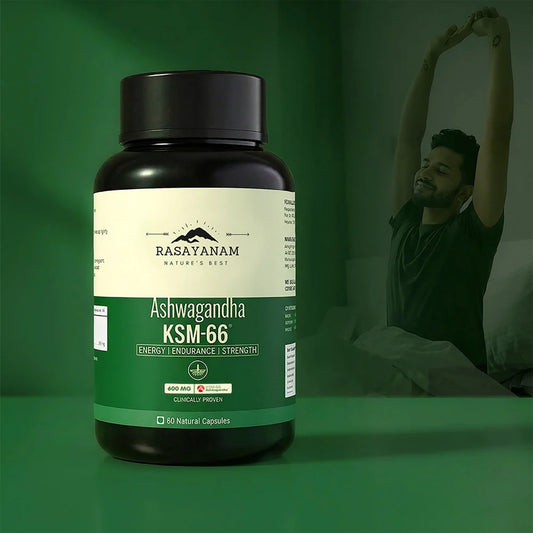
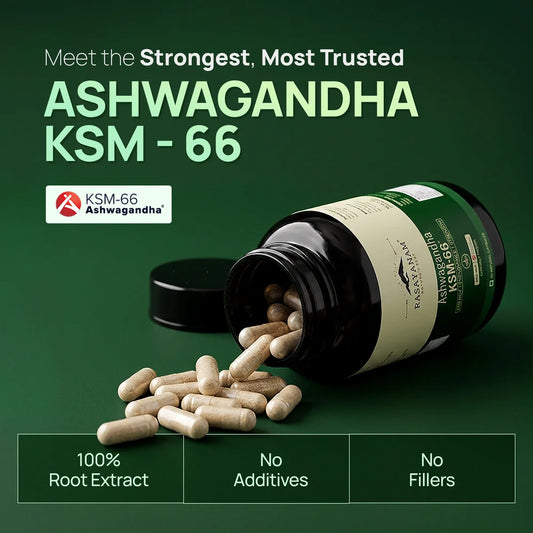
Rasayanam Ashwagandha KSM-66 contains a clearly defined, standardized extract of KSM-66. Each 600 mg capsule provides 5% withanolides. The full spectrum root extract contains no fillers or preservatives.
As it is 600 mg, you are getting a dosage in the typical range studied in human research. But it is important to understand your own situation to know what is right for you. It is tested for safety for heavy metals and contaminants as well as third-party lab tested for max results.
Overall, the best type of Ashwagandha to go for is one that you know the ingredients, composition, and purpose. It isn’t necessarily the most expensive or the one with the largest number is the best.
Frequently Asked Questions
1. What is the primary difference between KSM-66® and normal ashwagandha?
KSM-66 is a standardized root extract that contains a minimum of 5% withanolides. The normal root of ashwagandha can be of a more inconsistent nature and may not have details of how much withanolides are inside.
2. Is KSM-66 better?
KSM-66 has been researched around stress management, sleep, and physical performance. However, there is no evidence to suggest that KSM-66 is universally better than Shoden, Sensoril, and normal root ashwagandha.
3. What does a 5% withanolide content mean?
This means that ashwagandha is standardized to contain a minimum of 5% withanolides by weight. This gives an indication of what the composition is but cannot be used to predict how effective it will be for the individual.
4. Does the form of ashwagandha matter more than mg?
Yes. The form of the ingredient can give an indication of what the composition would be like. Knowing the dosage tells you how much you are getting. Giving you a more useful idea.
5. Can I take ashwagandha daily?
This depends on the formulation, dosage, and individual health. There is currently not enough evidence to know whether it is safe to take long-term. Speak to a health professional before taking any supplements, particularly if you are on medication or have an underlying health condition.
Disclaimer: Ashwagandha supplements are not a substitute for professional medical advice, diagnosis, or treatment. Benefits may vary between individuals, and side effects or medication interactions are possible. Consult a qualified healthcare professional before use.


1 comment