
































Multivitamin vs Individual Supplements: Which One Do You Need?

“Should I take B12?”
“Do I need vitamin D too?”
“What about magnesium?”
If you've asked yourself these questions, you're not alone. One supplement can quickly turn into three, four, or even more bottles on the shelf.
That’s where the multivitamin vs individual supplements debate becomes important.
Individual supplements can be useful when you have a specific nutritional gap. If you’re just looking for some daily nutritional insurance, a well-designed multivitamin may be a more convenient choice.
So, which one should you choose? Let's break it down.
Multivitamin vs Individual Supplements: What’s the Difference?
Multivitamins combine numerous vitamins and minerals in a single formula, while individual supplements focus on specific nutrients.
For example:
-
B12 supplement → B12 support
-
Vitamin D → Vitamin D support
-
Iron → Iron support
-
Magnesium → Magnesium support
-
Multivitamin → Multiple vitamins and minerals
Neither is better automatically. The choice is up to you, your diet, the nutrition you require, or a deficiency you find out about.
The Office of Dietary Supplements of the NIH notes that taking multivitamins helps meet nutritional requirements if there's any deficiency, but it shouldn't be a substitute for a balanced meal.
Why Are So Many People Looking for Energy Support?
Between rushed breakfasts, skipped meals, long workdays, and packed schedules, eating well every day isn't always easy. Over time, this can leave both men and women feeling drained or low on energy.
That is probably the reason that people, particularly women, are more commonly looking for multivitamins that can help with fatigue, weakness, etc., or even for multivitamins that can provide one with the needed energy boost throughout the day.
However, if one is fatigued, that does not necessarily imply one must take a supplement. There are many other things like insomnia, stress, unhealthy diet, or certain illnesses that may affect it. Therefore, when you are tired constantly or for a reason you can't explain, rather than just taking your supplements, you need to figure out what really is wrong with you.
When Do Individual Supplements Make Sense?
Individual supplements are best suited to a targeted approach.
If testing or professional advice identifies a deficiency, addressing that specific nutrient may be more appropriate than taking a broad formula.
For example:
Low B12? A B12 supplement may be recommended.
Low vitamin D? Targeted vitamin D supplementation may help correct deficiency.
Iron deficiency? Iron should ideally be taken under professional guidance rather than simply because you're feeling exhausted.
The idea is simple: if you know what you're missing, target it.
When Is a Multivitamin More Practical?
What if you don't have one identified deficiency but your diet isn't always consistent?
This is where a multivitamin can make sense. Instead of popping a bunch of individual supplements, you get a variety of vitamins and minerals all in one daily regimen.
This can be useful for both men and women looking for broader nutritional support.
If you're searching for a daily multivitamin for women or men, don't focus only on the number of ingredients. Check the actual nutrient profile and amounts.
Similarly, a multivitamin for fatigue and weakness shouldn't be viewed as an instant energy solution. Fatigue can have many causes, and persistent symptoms deserve proper attention.
What Does Research Say?
Studies point to the possible use of multivitamin-mineral supplementation, which can influence fatigue characteristics and cognitive performance levels.
One randomized, double-blind study involving 216 healthy women discovered multivitamin-mineral supplementation could lead to mental fatigue and cognitive function changes according to their measures.
Still, different people might have different reactions, and a multivitamin does not necessarily make someone more active or get rid of tiredness in all cases.
Multivitamin vs Individual Supplements: Quick Guide
|
If your situation is… |
Consider |
|
You have a confirmed nutrient deficiency |
Individual supplement |
|
Your diet lacks variety |
Multivitamin may be useful |
|
You need a specific nutrient |
Individual supplement |
|
You want broader daily nutritional support |
Multivitamin |
|
You already take several supplements |
Review the total nutrient intake |
|
You have unexplained persistent fatigue |
Speak with a healthcare professional first |
The goal isn't to take more supplements. It's to take the right ones.
What Should You Check Before Choosing a Multivitamin?
Before you shop for one, check:
1. Nutrient profile: See what's actually in there and in what quantities.
2. %RDA: Higher isn't automatically better.
3. Your needs: Age, meal plans, and lifestyle can affect dietary requirements.
4. Overall formulation: Beside vitamins and minerals some formulas contain plant-based ingredients, antioxidants and digestive enzymes.
5. Your diet: Supplements should complement nutritious food, not replace it.
What About Multivitamins for Women and Men?
For women, a multivitamin for women's tiredness shouldn't simply promise “more energy.” Look for balanced nutritional support and nutrients involved in normal energy metabolism.
Rasayanam Multivitamin for Women combines 55 ingredients across six functional blends, including vitamins, minerals, plant-based ingredients, antioxidants, and digestive enzymes.
Explore Rasayanam Multivitamin for Women
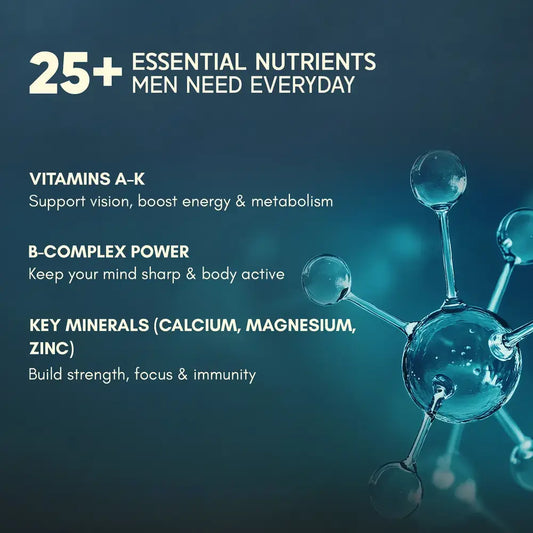
For men, the same principle applies. Rasayanam Multivitamin for Men provides 25+ essential vitamins and minerals, alongside natural herbs and antioxidants, designed for broader daily nutritional support.
Explore Rasayanam Multivitamin for Men
So, Which Should You Choose?
For a particular nutritional need, it is better to pick a single supplement rather than a combined or a broad-spectrum product.
If you're looking for broader protection or your eating habits are quite limited in variety so that you cannot get all essential nutrients from it regularly, then a multivitamin may fit the requirement better.
If you're suffering from an unclear or persistent form of exhaustion, keep in mind that adding more and more supplements to your regimen will not bring relief unless you find out the source of the symptoms.
What you're doing is not the most efficient method of supplementation. The right supplement schedule for you is a set of nutrients that meet your body's requirements only and are not superfluous.
Frequently Asked Questions:
1. Is a multivitamin better than taking separate supplements?
Not necessarily. A multi-vitamin is an easy and quick solution that provides the entire array of nutrients whereas individual ones can be better for treating a deficiency or the requirement for more of a particular nutrient.
2. Is it safe to have a multivitamin and individual supplements at the same time?
Sometimes. But please make sure that you have considered the overall quantities of each micronutrient. Taking together different supplements may cause a very high consumption of certain nutrients like vitamin A, D, iron or zinc, unintentionally.
3. Can I take a multivitamin even if I don't have a deficiency?
Some people take a multivitamin for filling nutritional gaps, but not everyone must take multivitamins. The choice will be influenced by the type of diet, the individual's age, lifestyle and, of course, nutritional needs.
4. Should men and women take different multivitamins?
Not necessarily, but nutritional requirements can differ. Formulas can be tailored to the needs of women and men respectively to cover their nutrients at different life stages.
5. How do I know whether I need a multivitamin or one specific supplement?
Reflect on your nutrition, signs and symptoms, supplements you’ve been taking, and nutrient deficiencies which have been diagnosed to date. When you are not sure get professional help as that will let you know exactly what you're missing.
Disclaimer: This article is for general informational purposes only and is not a substitute for professional medical advice, diagnosis, or treatment. Nutritional needs vary from person to person. If you have a diagnosed deficiency, ongoing fatigue or weakness, take medication, or have an existing health condition, consult a qualified healthcare professional before starting or combining supplements.


